
Structural restoration with Amir
Align the structure, ease the pain.
Amir has spent two decades working privately with students who are struggling with particular physical challenges, helping them unveil the habitual structural patterns that so often cause or intensify pain. Structural Restoration is the system that gathers everything learned across those two decades – ˜plus certified training in Fascial Stretch Therapy, Thai Yoga, Somatics, and Egoscue – into one guided, one-on-one practice.
Where his earlier one-on-one work treated alignment and pain as they arose, Structural Restoration is built around a simple idea: real change has to reach both what holds you together and what moves you.
Five modalities, one integrated system — untangling the body you forgot you had.
Every body is really two things working together: the structure that holds you (bones, fascia, the way weight and tension distribute through you); and the patterns that move you (the nervous system's habits, built up over years, often without your noticing). Change one without the other, and the old habit tends to quietly reassert itself into the new shape, or the new movement gets layered onto the same old structure. Neither change holds for long on its own.

What this is
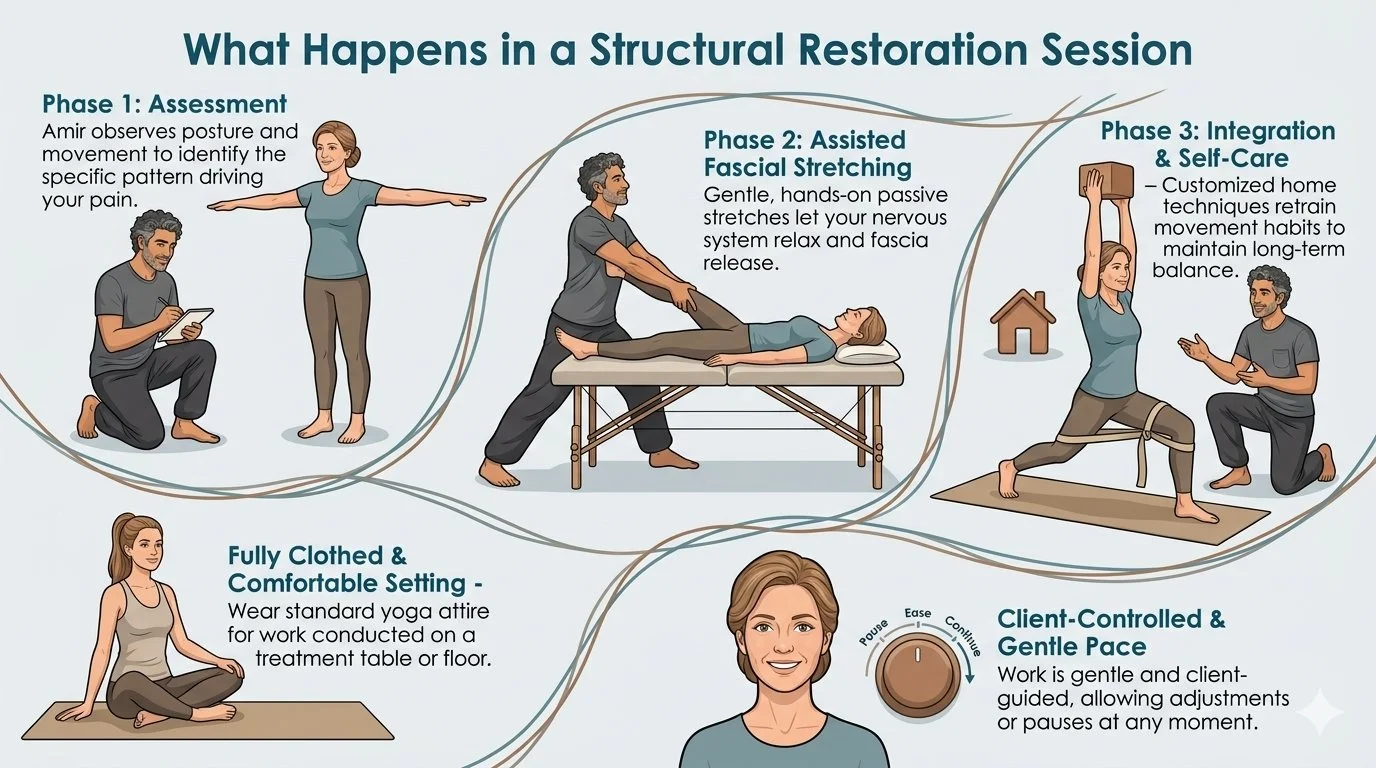
Structural Restoration is a hands-on, one-on-one session in which Amir guides you through a series of assisted yoga postures and stretches by after assessment or your body mechanics and reading your body's patterns as he goes. He adapts the session in real time to what your body needs. This following by customize techniques for you to take home and practice to achieve long-term improvements. It's an attentive, unhurried process, closer to being guided than being worked on. It is not massage, and it is not a substitute for medical care.
Who this is for
Structural Restoration is for anyone dealing with chronic pain or tension, as well as anyone who just feels tight and wants more freedom in their body. It's designed to create more space within the body by improving range of motion, restoring postural balance, and supporting proper joint function.
“What draws me to Structural Restoration is the way it bridges two very different traditions of knowledge — ancient and modern, East and West. Yoga Therapeutics and Thai Yoga emerged from thousands of years of careful observation; Fascial Stretch Therapy, Somatics, and Egoscue emerged from modern biomechanics and movement science. Two entirely different paths of inquiry, arriving again and again at the same truth about how the body actually works.”
Anyone with a body — no yoga experience required. That includes people managing:
That ache that's been hanging around longer than it should
Stiffness you've quietly gotten used to
An old injury that still makes itself known
Tight hips, cranky knees, a stubborn shoulder
Ongoing back pain
Feeling "tight" more days than not
A yoga practice that feels limited by an old injury or imbalance
How it works
Pain often comes from a pattern — how your body carries weight and compensates over time. When one part is out of balance, another part has to compensate for the imbalance.
The compensating patterns result in joint dysfunctions, muscular strains, and loss in range of motion.
Structural Restoration addresses the structure imbalances and retrains the nervous system that holds these pattern in place.
Customized techniques then rebalance what's off — so the change lasts.
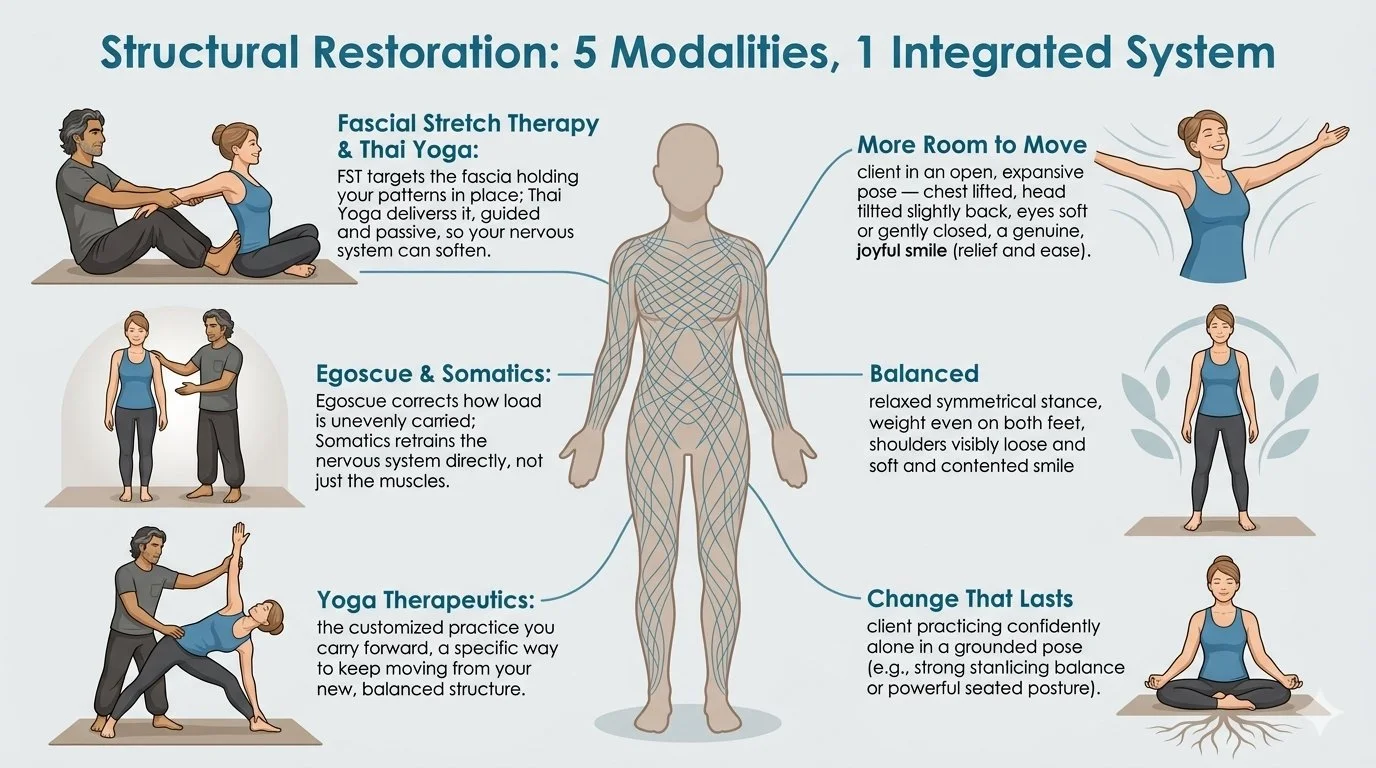
Based on 5 Integrated Modalities
Fascial Stretch Therapy (FST) targets the fascia – the connective tissue holding your structural patterns in place – and is where most of a session's change begins.
Thai Yoga is the technique used to deliver that stretch work: guided, hands-on, and passive, so your nervous system can soften its usual guarding.
Egoscue uses targeted exercises and postures to look at how load and posture are distributed through your structure, and to help correct where it's unevenly carried.
Somatics works with the nervous system directly, helping it let go of habitual movement patterns rather than just relaxing the muscles around them.
Yoga Therapeutics becomes the practice you carry forward — a small, specific way to keep moving from your new, more balanced structure.
How it’s different
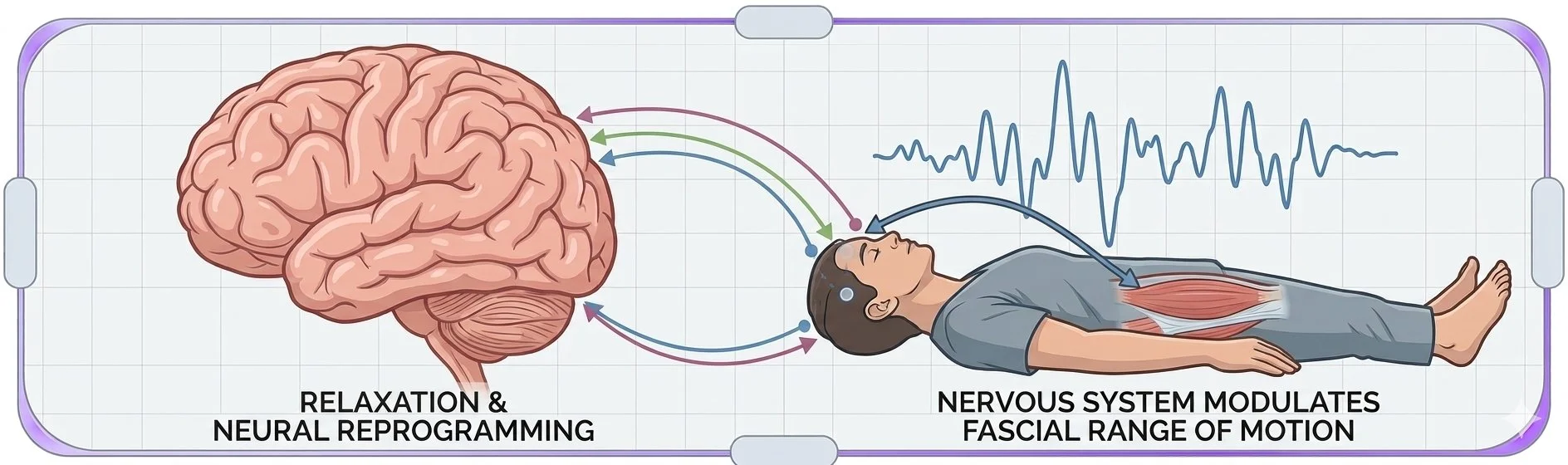
Fascial Stretch Therapy and Thai Yoga combine into what a Structural Restoration session calls Assisted Fascial Stretching (AFS): the hands-on core of every session.
This is different from conventional single-modality approaches (such as massage, stretch studios or chiropractic), which typically work through one method at a time. Structural Restoration brings five distinct approaches together into one integrated system, addressing structure (myofascia) and pattern (neurofascia) together for both immediate and long-lasting relief.
The Structural Restoration Program
Structural Restoration starts with one longer session to get oriented, then continues with regular sessions tailored to where you are in the process.
1. Foundation Session — $175 A longer first appointment (80 minutes): a full assessment, a full AFS session, and a first customized technique to take home. This is where you and Amir both find out whether this is the right fit for your body, and for how you like to work.
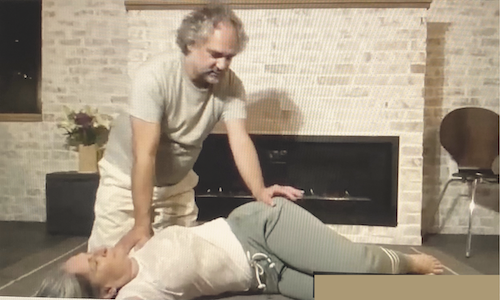
2. Realignment Series Every session after your Foundation Session is 75 minutes, and it's tailored to what you need that day — sometimes more Assisted Fascial Stretching (AFS), sometimes more Egoscue, Somatics, or Yoga Therapeutics integration, depending on where you are in the process. As your pattern stabilizes, a session naturally shifts toward either more AFS or more integration and self-care as needed, but the format and price stay the same.
Single session: $160
3-Session Package: $450 ($150/session)
5-Session Package: $700 ($140/session)
There's no fixed number of sessions required. Amir will recommend a starting package after your Foundation Session, and you can continue for as long as it's useful to you — or stop anytime.
What to expect, session to session
Every session is designed to leave you more balanced than you arrived. That has been true across two decades of Amir’s Yoga Therapy sessions, and it holds just as true now that Amir is using five methods to work together. How much that translates into lasting relief depends on you and on what's actually driving your pain. What stays consistent is the aim: guide your body toward a more balanced position, and send you off with a way to keep practicing from it.
It is designed as an ongoing process rather than a one-time fix. Each session builds toward better alignment, and over time you're taught how to maintain and build on that alignment yourself, which is what supports change that actually lasts. How many sessions that takes is different for everyone; there's no fixed number. You're always free to stop at any point if you decide it's not the right fit for you.
A note on touch and consent
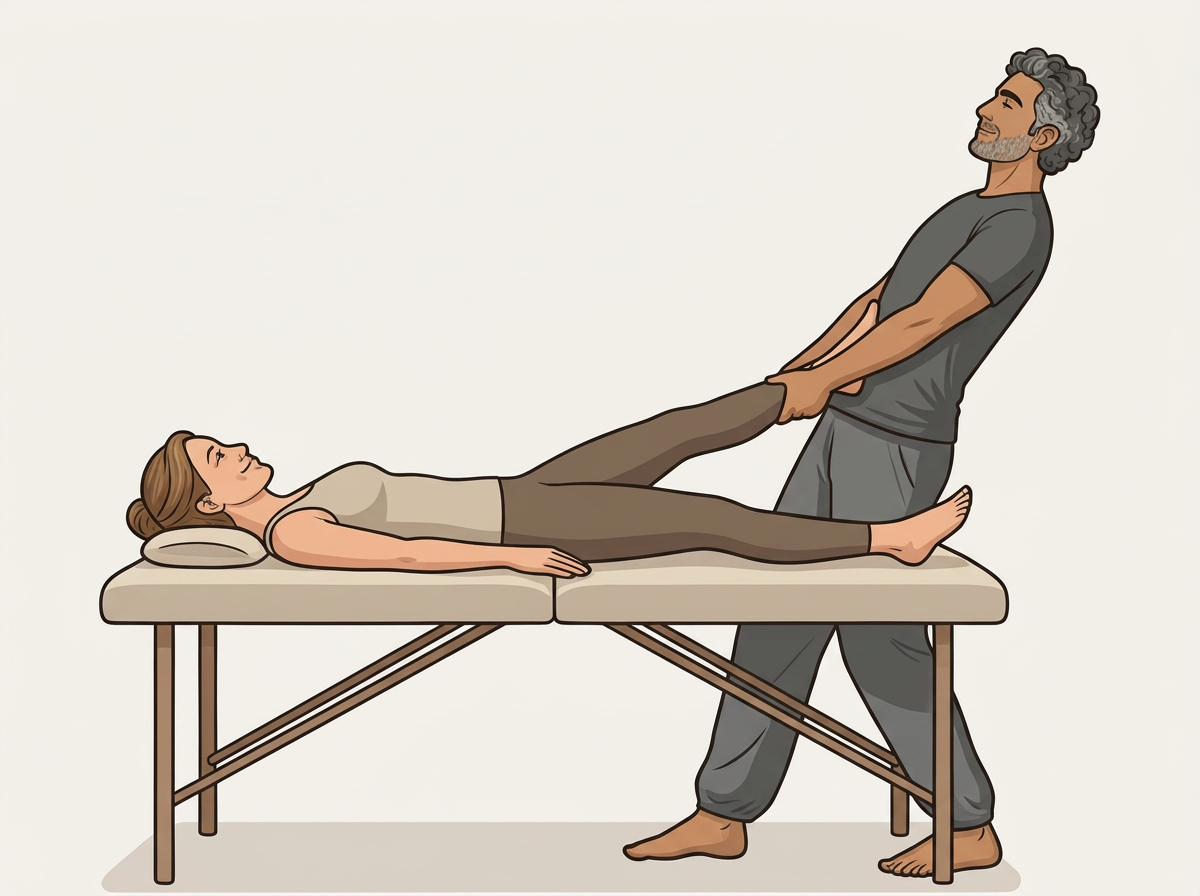
Amir is a male practitioner, and this work is hands-on by nature. You are in control of the session at every point. You can ask to pause, adjust, or stop at any time, for any reason, no explanation needed. Sessions are done fully clothed in whatever you would wear to a yoga class, and they place in the same studio room used for classes, when no class is in session. Depending on what a session calls for, work may happen on a treatment table or on the studio floor. The door stays closed, though there's a window to the hallway, so it isn't fully private; everyone remains fully clothed throughout.
If hands-on work is new to you, it's completely normal to feel a little unsure going in. Nothing about it requires prior experience, and the pace is always set by what feels right for you.
About Amir
Amir is an ERYT-500 certified yoga teacher who has taught for nearly three decades, and a well-known yoga therapist who has helped thousands find relief from back, knee, hip, shoulder, and foot pain through his popular Yoga Therapy Workshops. He has worked privately with yoga therapy students for the last two decades. Structural Restoration is his integrated system — Fascial Stretch Therapy, Thai Yoga, Somatics, and Egoscue, woven together with his original Yoga Therapeutics practice — and replaces his previous one-on-one yoga therapy offering.
Frequently Asked Questions
What should I wear, and do I need to bring anything? Whatever you'd wear to a yoga class. No need to bring a mat; Amir will set up whatever the session calls for, whether that's a table or the floor.
Where exactly are sessions held? At Sun & Moon Yoga Studio, 3811 Langston Blvd., Arlington, VA
How do I get started? Every client begins with a Foundation Session — see above for what that includes.
What's the cancellation/rescheduling policy? Because appointments are limited, a 24-hour cancellation policy applies. If you cancel within 24 hours and the slot can't be filled, no refund is given. If the slot can be filled, you'll receive a full refund minus a $15 processing fee.
Is this safe if I have a specific injury or health condition? Most common aches, tightness, and joint issues are a good fit — see "Who is this not a good fit for?" below for the specific exceptions.
Who is this not a good fit for? This works well for most people, but it's probably not the right fit if:
You're looking for a one-time fix rather than an ongoing process you build on over time
You're not comfortable with hands-on, guided touch from a practitioner
You're currently in an acute flare-up or a level of pain that makes it hard to relax — this work depends on being able to settle into the stretch, so it's better attempted once the acute phase has passed
There are also a few health conditions this isn't appropriate for: a recent fracture, surgery, or acute injury in the area being worked; an unstable spine; severe, uncontrolled osteoporosis; an active blood clot; uncontrolled high blood pressure or a heart condition; active infection or fever; or a neurological condition that affects your ability to sense or communicate discomfort.
If you have a hypermobility condition (such as Ehlers-Danlos) or a disc herniation, this can often still be a good fit — just let Amir know ahead of time so the session can be adapted safely.
This work also involves supporting and guiding your body's weight through a stretch, which has practical limits. If you're very frail, or your body size falls outside what one practitioner can safely support alone, reach out before booking so we can figure out together whether this is a safe fit.
I'm not flexible, and I've never done yoga — can I still do this? Yes. This is for everyone, regardless of flexibility or yoga experience.
Is this appropriate during pregnancy? Amir isn't currently taking pregnant clients for this work.
Is there an age range this works best for? Generally, ages 18 to 80.
Can this help alongside physical therapy or chiropractic care I'm already doing? Yes — Structural Restoration can amplify the effectiveness of those types of care.
Does it hurt? Is it intense, or gentle? By design, it's gentle. If anything starts to feel intense, let Amir know right away — sessions are always kept within what's comfortable for you.
Do I need to do anything, or is it entirely passive on my part? The stretching itself is passive — you're relaxed and supported throughout, though you may occasionally be asked to participate in a movement. The Yoga Therapeutics portion at the end is active, guided by what your session calls for.
What does it actually feel like, if I've never experienced hands-on assisting before? Like having yoga poses done to you, in an attentive, therapeutic way.
How is this different from a regular yoga class, if I already take Amir's classes? In class, you practice using your own energy and mindfulness, and repeating that practice is what maintains its benefits over time. Structural Restoration is one-on-one: postures are performed on you while you're relaxed, in a therapeutic manner, and afterward you're given customized postures and techniques based on your specific assessment.
What's Amir's background and training? Amir is an ERYT-500 certified yoga teacher who has taught yoga and Yoga Therapeutics for over 30 years, with additional certifications in Fascial Stretch Therapy, Thai Yoga, Egoscue, and Somatics.
Do you have client stories or testimonials? [to be added]
Is this covered by insurance or HSA/FSA? No.
Required for First Time Clients
Select for after your first session